
Gateshead covers a lot of ground, and its homes are just as varied. Low Fell has Victorian and Edwardian houses along and off Durham Road, Bensham and the streets near Saltwell Park have Tyneside flats and terraces, and Whickham, Felling and Ryton mix older village cores with post-war and modern estates. Whatever kind of home you have, replacing windows and doors in Gateshead starts with understanding what was built there in the first place.
We work across the river from our Newcastle base, and on this page we explain how the rules and the right products change from one part of Gateshead to another.
Gateshead Council, planning and conservation areas
Homes south of the Tyne fall under Gateshead Council rather than Newcastle City Council, so any planning questions go to Gateshead's planning team. The general rules are the same across England: most like-for-like window and door replacements on houses are permitted development, while flats, listed buildings and homes in conservation areas can need permission.
Parts of Gateshead, including some of the older village centres and Victorian streets, sit within conservation areas, and Article 4 directions may apply to some of them. We would never assume either way. Check your address on Gateshead Council's website or ask its planning team before you order anything, and tell them exactly what you plan to change.
Tyneside flats in Bensham and Saltwell are flats in planning terms, so they do not have the same permitted development rights as houses. Always check with Gateshead Council before replacing windows or doors on a flat.
Which windows suit which part of Gateshead?
Low Fell and Saltwell
The period homes in Low Fell were mostly built with sliding sashes and bays. A sash replacement or a well-proportioned casement that keeps the original glazing pattern will look far better than a plain modern window. Where budget allows, keeping sashes on the street side and using uPVC casements on the back is a practical compromise.
Bensham and the Tyneside flats
As in Heaton across the river, these flats come in upper and lower pairs with separate front doors. Upper flats need windows that can be cleaned safely from inside, and bedroom windows may need to act as fire escapes.
Post-war and modern estates
Many homes on Gateshead's newer estates still have their first set of uPVC windows. These are often ready for replacement because the units have misted, the hinges have worn or the frames simply look tired. Modern uPVC casements are warmer, more secure and more stable than the frames fitted 20 or 30 years ago.
Hillside homes and the weather
A lot of Gateshead is built on slopes rising from the river, and homes in places like Whickham, Sheriff Hill and the higher parts of Low Fell can be quite exposed. The wind tends to come from the west and south-west, and on an open hillside it drives rain hard against the glass and frames.
On these elevations, good seals, properly sized drainage and a careful installation matter most. On the coldest and most exposed walls, triple glazing can be worth considering, although a good double-glazed unit with a warm edge spacer is usually enough. Homes with long views often face the weather too, so it pays to think about where the wind comes from before choosing which windows open.
Bi-fold doors and opening up the garden
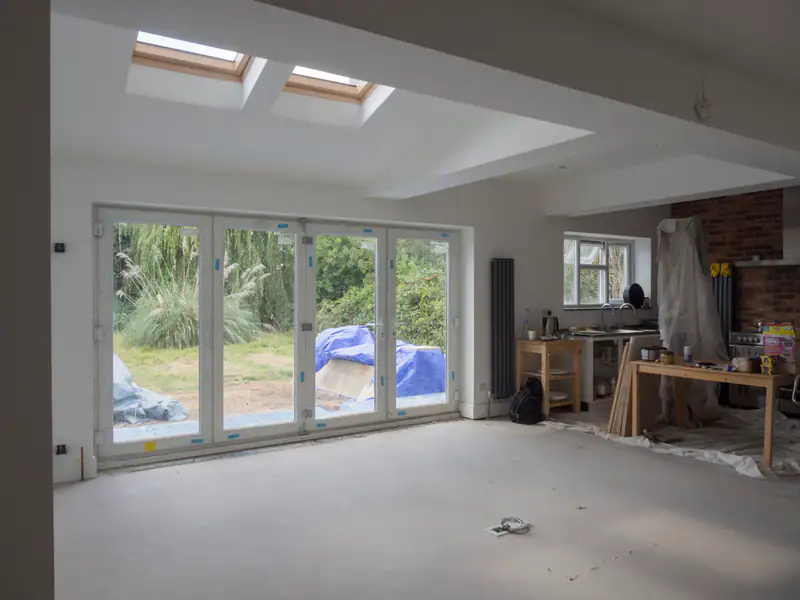
Many Gateshead family homes have gardens worth looking at, and opening the back of the house is one of the most popular projects we quote for. Bi-fold doors fold back to open almost the whole width, which works well for a kitchen or family room leading out to a patio.
A few points to weigh up:
- Opening width: widening an existing opening usually needs a new lintel or steel beam, and Building Regulations approval for the structural work.
- Traffic door: most bi-folds include a single door for everyday use, so you do not have to fold the whole set back to nip outside.
- Thresholds: a low threshold looks neat but needs good drainage outside, especially on a sloping plot.
- Alternatives: sliding patio doors give bigger glass panes and fewer frames when closed, while French doors suit smaller openings.
Are conservatories still worth it in Gateshead?
A well-designed conservatory can still add useful space, especially on a family home with a reasonable garden. The old problem with conservatories was temperature: too hot in summer and too cold in winter. Modern designs deal with this much better through better glass, insulated roofs and more solid walls.
If you already have a conservatory that is uncomfortable to use, replacing the roof is often more cost-effective than starting again. If you are building new, you may want to look at an orangery, which has more solid walls and a roof lantern. Our pages on conservatories and replacement roofs explain the options. Most conservatories on houses are permitted development within size limits, but check with Gateshead Council if you are near a boundary, in a conservation area or adding to a property that has already been extended.
Keeping windows and doors secure
Security is one of the main reasons Gateshead homeowners replace older doors. Modern doors use multi-point locking that engages at several points along the frame, along with anti-snap cylinders that resist a common method of forced entry. Windows with internally beaded glass are harder to remove from outside, and lockable handles add another layer.
Front doors are where many Gateshead homeowners start. A composite door combines a solid insulated core with a wide range of traditional and modern styles, so it suits a Low Fell terrace as well as a newer family home.
Back doors and patio doors leading onto rear lanes or gardens need as much thought as the front door. We check the frame fixings as well as the lock, because a strong lock in a poorly fixed frame will not stop a determined intruder.
Whichever part of Gateshead you live in, use the form on this page and we'll arrange a free survey to look at your home and give you a fixed, itemised quote.